Sunday, 28 August 2022

To do with birds

 I'm putting this image first to get it on Facebook.  It was get explained a bit further down.

My first effort today was a bike ride to Bucklands to see if the Nankeen Night-Herons were around.  They weren't, as far as I could tell.  En route I checked the huge fig tree opposite the school bus stop for fruit: very little that I could see,

Getting past Mullet Creek I looked back at the jetties and realised that I had 5 species of Cormorant and relatives in one image!

1 Little Pied Cormorant; 2 Little Black Cormorant; 3 Great Cormorant;
4 Pied Cormorant, 5 Australasian Darter
I have previously managed to get these 4 Cormorant species + Black-face Cormorant in one shot (on the Breakwater at Glenelg SA) but never before 4 Cormorants and a Darter.

Here is a closer shot of the Great Cormorant and the Pied Cormorant.

A little further along Lakeside Drive (the jetty near Schnapper Point Drive) I spotted a familiar shape on the jetty.
Yes!  A Squidgy Heron.
I came back over Stingray Point mainly to check the figs by the grassy area,  Both trees seemed covered with fruit so will I think be good for Figbirds, Topknot Pigeons and Channel-billed Cuckoos a little later in the season.  On the way down the hill I saw this person checking things out.  Laid back as usual and only about 1.8m off the ground.
We then went off to the Bunker Museum site to check out the BLA nest boxes to see if there was any activity.  The opening image is me preparing to insert Caroline's pole camera into one of the boxes.  (That was the second highest we found: I couldn't get the probe in the highest.)  Here is the route we followed: the pink ring is the site of the Bunker.
In total there are 33 boxes here: 20 put up by BLA and 13 by the Historical Society.  We found 26 of them, but none were currently occupied.  Here is a link to a summary.


Tuesday, 23 August 2022

Mainly seasonal stuff

 Of course with that title, my first two snaps are not seasonal: sunrises occur daily and colourful ones at any season!  The first view is from the deck looking North (as proven by Mt Imlay).

The second was from the Street, with a good bit more East in the orientation.
My main outing for the day was to the Waste Water Treatment Plant (aka poo pits) to hopefully add a couple of missing species to the monthly list.  I walked in from the Tip, seeing some nice bush along the way.  Acacia longifolia is getting its act well together.
A less flamboyant wattle is Acacia myrtifolia.
As always Spyridium parvifolium stands out in the bush because of the white, dusty-looking, leaves (hence the vernacular name "Dusty Miller").  The flowers are tiny and not all all obvious unless really looking closely.
Epacris impressa is beginning to impress.
Hardenbergia violacea is crawling up in most places.
Australian Shelduck were in the usual numbers (I think at least 10) on the ponds.  This group of 4 appeared to be in a mating display.
At times both the males adopted this position.  From reading the accounts in HANZAB for several Shelduck species this appears to be a response by the male to incitement by a female.
I noticed this Black-fronted Dotterel in a cleared area.  I subsequently noted 3 others in a gravelled area, which would appear to offer nest site potential.  As none of them did a distraction display I assume they haven't yet laid their eggs.
Some could define a bird as "a thing with wings" in which case a passing Roulette could fit the bill.  It did one lap of the town then one of the pits before heading back in the general direction of Sale.


Sunday, 21 August 2022

Of matters E

 I visited the marsh near Fisheries Jetty this afternoon in search of Emuwrens (or Emu-wrens - I'm not sure how the Hyphen Police are viewing matters this week).  Before getting to the area where they might be found I noticed some Egrets.  In view of recent discussion of them I took a few snaps.

This is a basic photo but it shows the gape going past the eye and the relatively long neck.  Measuring on my computer screen the neck was 38mm long and the body about 34mm.  Both good for Great Egret.

Again note the gape and also the kinked neck.
A second bird maintaining the kink in the neck while killing something.
Now they are what you call kinked necks.
As I left both birds had gone up in the world.

Here is my overall track per eBird.   The Egrets were on the peninsula bit, and I hoped to find the Emuwrens on the inland part of the loop.  
I played the call a couple of times with apparently no response.  So I moved on about 40m and it seemed my phone had carried on playing, even though I had turned it off.  Dohhhhh!  I got very good views of a male Southern Emuwren, including flying between bushes which really emphasised the length of the tail.  It didn't show itself well enough or long enough for a photo.

Here is what the 'ground' was like.  Wellies are recommended!!
A Caspian Tern flew over, Little Grassbird called from cover and a Pied Cormorant (with long ivory bill was fishing offshore.  As I left I glanced at the pool beside Lakeside Drive.  The number of Chestnut Teal had increased from 8 to 34 while I had been walking.  
Overall I recorded 22 species in about 40 minutes.

I have added below some photos of a pair of White-faced Herons making nice in the Angophoras next to our house.


Tuesday, 9 August 2022

Kiah sculpture

 An alert reader will notice that this post doesn't directly show anything about weather, wildlife or Mallacoota but I think it is close enough. We stopped at the Kiah store on the way back from Eden to fill up my car with diesel: it was 216.7 c/l, compared with  237.9 c/l in Mallacoota.  

There was a very good bit of sculpture beside the driveway, which does reference the 2019/20 fire, so that justifies the inclusion.


On checking Jesse's website I found that "2020 Vision" was installed at Jindabynes Lakelight Sculpture Competition in 2021 as well as Sculpture Bermagui where it won Peoples Choice Award in both competitons!"


Sunday, 7 August 2022

Orchids a squillion, Cuckoo-Doves nil.

 Feeling somewhat less disease-ridden on 6 August I decided to go for a snuffle at Gipsy Point to checkout the greenhood orchid and Brown Cuckoo-Dove situations.  My expectations were positive for the former and less optimistic for the latter.

And so it was.  The majority of the orchids seen were on the roadside heading down to the Lodge boat ramp.  (There may have been other species present which I didn't identify.)

Pterostylis nutans: Nodding Greenhood

One of the many clumps of noddies.
Pterostylis curta: I saw these on the visit on 6/8, but didn't photograph them until calling in again on 8/8.  I didn't get a good image of the diagnostic twisted labellum, but did see that feature.


Pterostylis pedunculata: Maroonhood.  Not in such large numbers as the previous species but still a good crop.
I'm reasonably sure this Pterostylis concinna: one large clump towards the lower part of the track.  Much smaller than the noddies (as well as the flower not nodding).
Only one patch but lots of them!
One specimen from the Tall Greenhood group: Pterostylis melagramma.
Although the sought-after Dove was not evident there were quite a few birds around the relevant site.  The red Camellia was particularly popular with Little Wattlebirds.

Satin Bowerbirds were also common, including this very spiffy adult male.  It seemed to play "peek-a-boo" around the mobile chook pen!
The female/immatures watched on from a distance.
There has been some discussion on another FB Group about a Handsome Rooster seen at a campsite in Northern NSW.  This looks to be a very similar bird.  Do they migrate?
Parrots were also evident.


Saturday, 6 August 2022

Weather of early August

 My monitoring of daily extreme temperatures (ie daily minimum and maximum) has been very interesting for the first 5 days of August 2022.  On all 5 days both measures have been well above the long term average for the date.

Following discussion on a weather chat group a simple way of summarising temperatures is to compare the current values of the average temperature with a longer term mean value of the average temperature.  As most sources quote the daily extreme temperatures rather than the average daily temperature an indicator of average temperature is calculated by  (current daily max + current daily min) / 2.  A similar bit of arithmetic - but obviously with more periods involved - is used to calculated the longer term mean.

So I calculated the average temperature for the period 1-5 August 2022 as 14.03C.  The average for the first 5 days of August for all years since 2001 was 10.82C, 3.1C lower.  Plotting the average for each year gives the following.

Clearly early August 2022 has been unusually warm (but not as much so as August 2011.

The other interesting aspect of the weather this year has been the rainfall.  We are now up to 883mm for year, and thus just over the median annual rainfall despite only being 218 days into the year.  My prorata estimate suggests that if things carry on as they have we'll score 1477 mm for the year.  Should that happen it would be our wettest year since records began here in 1975 (~30mm more than the current record of 1442mm in 1985).


Monday, 1 August 2022

A few snaps from the vicinity of Broome St

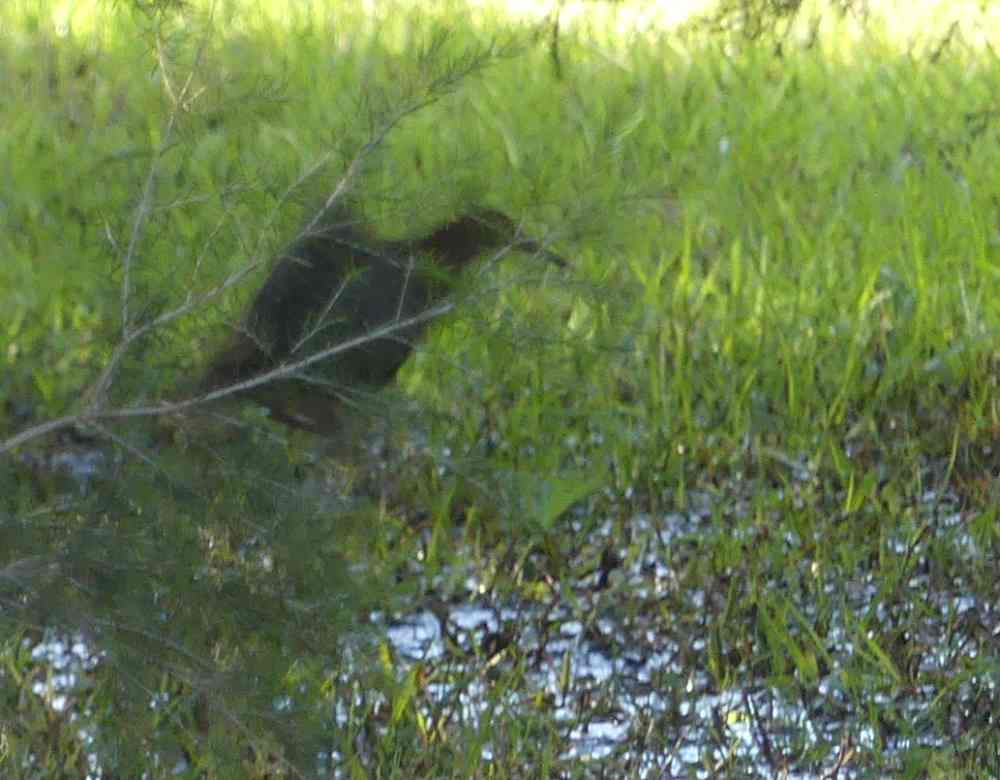
A few days ago I was told of a sighting of Lewin's Rail.  As this was about the 5th sighting of the species in the area I thought it worth a twitch.  As it was a flat 300m walk I reckoned I could make it there.

On my first visit (30 July) I thought I had one brief glimpse of the Rail, and couple of possible calls, but not enough to claim the bird.  On 31 July I tried again and got a clear enough view to make the claim, but no photo.  What follows is of my visit on 1 August where I staked the site out for an hour.

I parked at Fisheries Jetty and walked along the boardwalk to the end of the scrub, where I erected my folding chair.

This is the area of interest.  On each visit the bird has bolted across the area of very shallow water.  On one occasion it went from L to R and on the other it went from L to R.  The vegetation on the right is very dense an there is no chance of seeing the bird once it is in there.  I suspect that sometimes when the bird crosses to the left it goes through the very thin layer of bush and into a very heavily overgrown grassy swamp.  Again it will never be seen  if it stays at ground level.
On 1 August it decided to tease me bolting across the water in either direction about ever 15 minutes.  My guess it was generally in view for less than 2 seconds (and covering 3 metres in 2 seconds implies a speed of about 6 kph which is quite feasible).  That is very much of an ask to get a photo: get the camera out of hibernation; zoom in to the area; shutter lag; incompetence.

The local Scrubwrens were more cooperative.  

I hoped that their presence might persuade the Rail it was safe to stop for a pose in the middle.  After an hour that was almost the case.  I think this indicates enough to support my sighting,
That is very far from my worst effort at photographing a bird.  When we lived in New York I went for a prowl in Central Park one day and another, camera-free, bird had identified an Ashy-throated Flycatcher which would be a first for the Park.  It was a very active and my camera was not cooperating so the other bloke to off to bring an expert from the mob about 300m away watching the famous Red-tailed Hawks on 5th Avenue.  Needless to say the bird was well gone by the time they returned.  I had taken a couple of snaps but all they showed was a gray (noting the location) blur.  NYC Audubon were reluctant that they could not accept the sighting.  That was my worst effort.

2 weeks later a specimen of the species was seen and acceptably photographed some 200km North, become the first record in the Great State of Connecticut. 


July 2022 Weather Report

 I have completed my initial work on the Census, but am now afflicted with a revolting cold and finding it best to lie in bed rather than sit at a keyboard.  So this will be a very brief summary of what has happened, weatherwise.  

I am tempted to say the month was looking towards a return of La Nina: damp and a little warmer than average for the month.

Rain

For my weather station (WS) overall 105.6 mm of rain fell, amounting to 153% of the median fall for July.  The BoM Mallacoota site recorded 96.6 mm (130.4% of average) while Gabo Island was at 85.0 mm (114.7% of average). 

Of the 42 Julys for which I have records (BoM Mallacoota prior to 2019) only 9 had higher rainfall.  

That has ended, at 2, the run of months in a row of below median rainfall.  Hanrahan should be resuming his seat.

Temperatures

The anomaly (difference between current average temperature and long term mean) was +0.08C.  Effectively saying that on average it was about normal.  However days with an above average minimum and below average maximum were well over-represented in the mix.  This was the net effect of a warm start to the month followed by a cool patch from 11 -21 June with a brief return to warm before a cood conclusion.  This is illustrated by a chart of BoM data.

The mean daily minimum temperature at the BoM was 7.38C compared to a long term average minimum for July of 6.3C.  The lowest temperature recorded there  was 2.1C on the 31st.  For my WS the daily average minimum was lower, at 7.07C with a monthly low of 2.8C on the 20th.  In terms of impact on our activities there were a few mornings where the temperature was low enough to make the wooden boardwalks along the Lake treacherous

The mean daily maximum temperature at the BoM was 14.13C compared to a long term average maximum for July of 15.0C.  The highest temperature recorded there was 19.2C on the 17th.  For my WS the daily average maximum was a tad lower, at 13.87C with the same monthly high of 19.2C on the 17th.

Overall the two data series correlate well with R2 values of 77% for Minimum and 95% for Maximum.  It was surprising to find BoM higher than my WS by ~3C on a few  mornings: I attribute this to a warm(er) sea breeze than the air emerging from the Narrows and impacting my WS.

Humidity

My WS has recorded average humidities for the month at 0900 hrs of 86.2% and at 1500 hrs of 77.5%.  For both times these values are above June 2019 and the average for the 3 earlier years for which I have records (BoM doesn't have free access to historic humidity data).  This is not surprising considering the well above median rainfall.