Showing posts with label moon. Show all posts

Friday, 14 July 2023

Back in Mallacoota

 We had a relaxed drive back to Mallacoota on the 12th July and found a few things of interest on the 13th.  For some reason I found the day cold, while the thermometer said it was actually quite warm, with a maximum of 19.4C.  Frances suggested that if I went and sat on the deck I would soon warm up: this happened.

It also gave me a good view of this patch of clouds.


The patch seemed to be moving quickly towards the North.  This made me recall that on our morning walk I saw a condensation trail heading South which seemed an unusual time for this.  Checking with Flight Radar it was simply a Sydney-Hobart flight which is quite common - perhaps I just haven't looked up at the right time in the past?  Taking a rough guess, using the distance in the image to Cann River as similar the aircraft was about 50km out to sea.  The most interesting point was that it was only travelling at around 380 knots: my memory is that they are usually doing about 450 knots.  There must have been strong Southerly winds.  This would account for the speed of the clouds also.
The Lapwings nest on the lawn next door is full.
A New Holland Honeyeater perched in a Grevillea.

Some more clouds arrived to make a spiffy sunset.

Sunrise on the 14th was pretty spiffy also.
The reflection of the sky in the Lake is just visible in this.
The moon, such as it is at present, also appeared.
On our morning walk, a seal feeding between the shore and Seagull Island entertained us.  Sorry, only phone photographs.

In the evening the sunset was one of the best I have seen.  The first photo was with my larger lens looking towards Karbeethong.
The next two are a little later looking North (see Mt Imlay) and photos using the small lens

The final image was taken from the lounge


Sunday, 25 June 2023

Sundry snaps for Mallacoota, mid June

 What is in the title!

A neighbour was able to show me a Bassian Thrush i his yard, ending some months of searching for a sighting of this species.


A crescent moon.
Female Scarlet Robin seen on a drive around the are which spotted 41 species in an hour!
Two Cattle Egrets (ibid) 
The Nauta Tce Emu, sighted for the first time in several months.
A comfortable Pelican.
A pleasant sunset, taken on my iPad through a double-glazed window.
An Azure Kingfisher takes flight.
Later on 24th we walked the Betka Loop.  At Point Difficult we saw, but could not photograph, at least 6 Whales swimming past, about halfway to the horizon.   I did get a snap of a Sooty Oystercatcher on the rocks below.
On the 25th I went to Geology Point to see if there were more whales around.  There were not - or if they were they were staying out of view.  However a search for Southern Emuwren delivered the goods.

On the afternoon of 25 June we walked the Heathland track.  We saw another 3 Emuwrens as we did so: adjacent to the seat in the heath.  Earlier we had seen an Echidna near the bridge on the Chip Track  ...
... and several specimens of Dillwynnia sericea.  As we also saw blossom on Hakea and Allocasuarina there are signs that Winter will end (if a day with a maximum of 19.4C can be called Winter!)


Friday, 7 April 2023

Huge Bat flyout

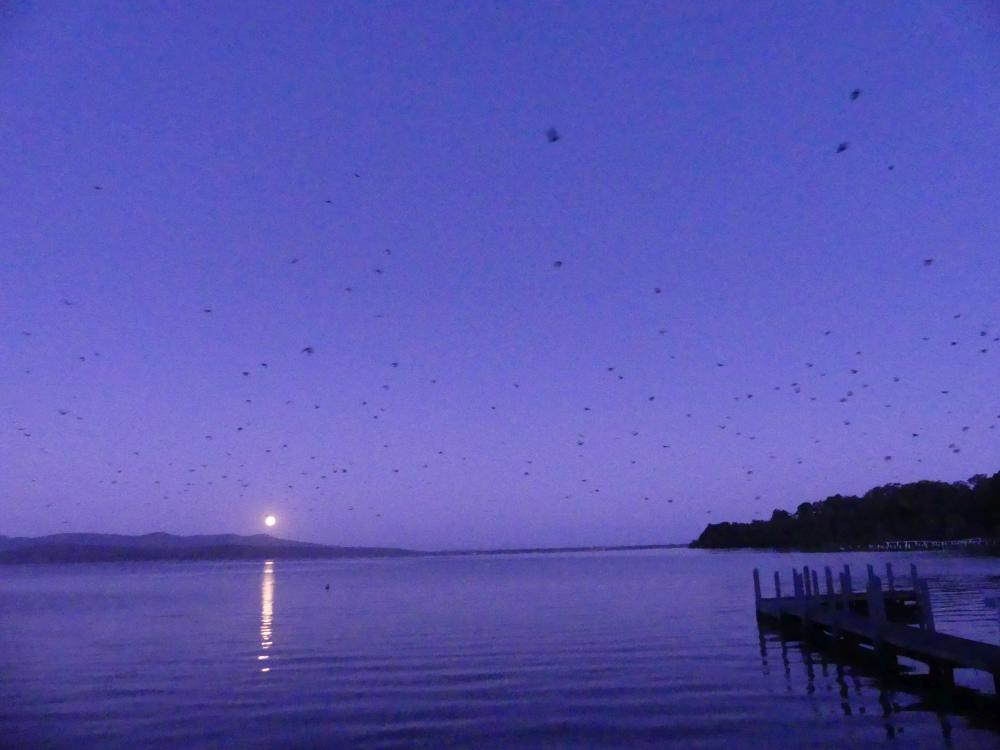
 Frances picked that there was a full moon rising at 1754 on 6 April.  So we took ourselves down to see what the bats were up to against the rising moon.  A massive flyout is what they were up to.  We were in position by 1758 hours and while the bats were swirling above the camp and making a ruckus there ere no obvious signs of a flyout.  The first group headed over towards Lakeview almost exactly on 1800 hrs.  From then on it was a massive flyout.  

The beauty of the full moon is obvious.  This evening there was light cloud (which nearly made us decide not to go).

We were surprised to see a number of the bats flying low to the water and in some cases actually hitting the surface. I shall enquire as to the purpose of this.


The usual line of light was established.
As I said a massive flyout.  This is 1809 hrs, looking back at the camp.
Most times we have watched before the main stream has been going in apparently one direction.  This night there seemed to be large streams heading to Lakeview, towards town and up The Narrows.  In other words they were going every which way.
An arty shot of bats and moon.
By 1817 hrs it was getting too dark to really see what was going on, but there were still a lot of bats going out.  However we left and got another arty shot of the Jetty as we turned round.
So, how many bats were there?  I really don't know but one of our earlier visits was close to the time when the camp was estimated at 4,000 bats.  The flyout that night lasted for about 10 minutes, and seemed to be nearly all heading to Lakeside.  On 6 April the flyout lasted at least 17 minutes and there seemed to be 3 more or less similar sized streams.  So for order of magnitude I'd say (4000*1.7*3 =)  ~20,000 bats.

Wednesday, 8 March 2023

Full Moon and Bats

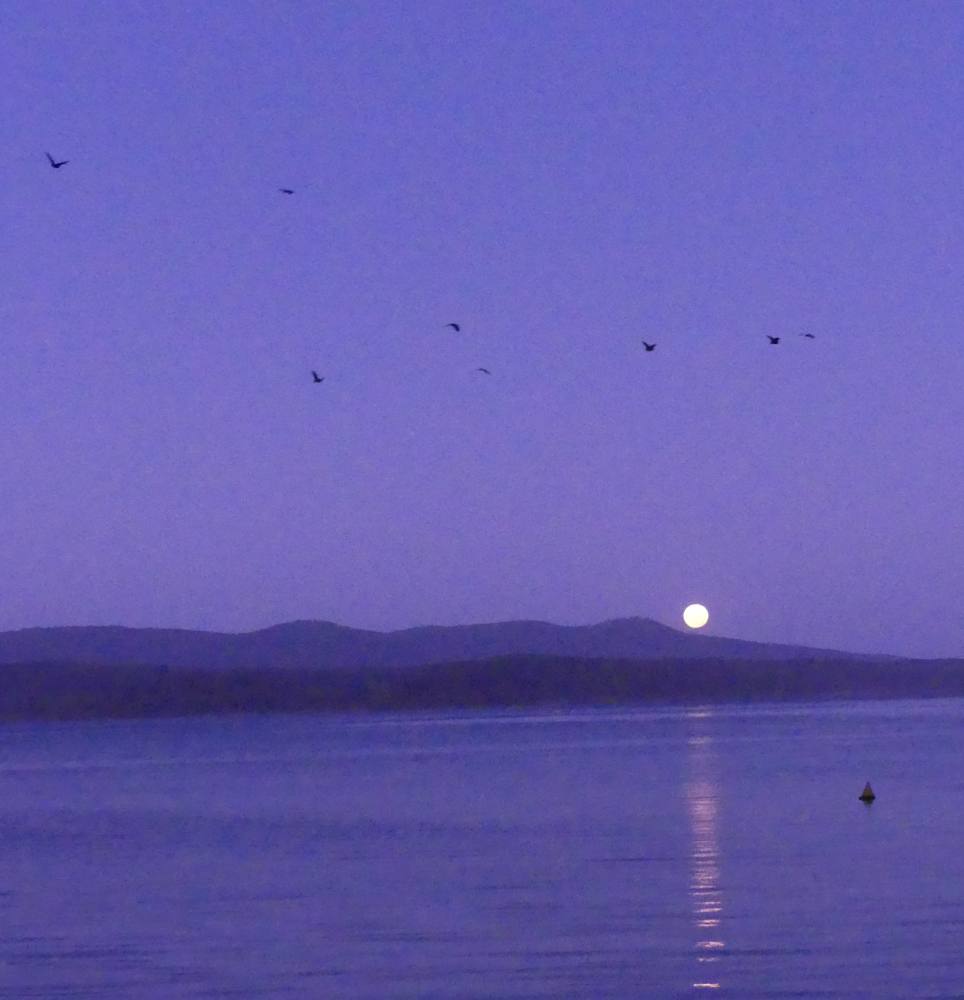
 It had been suggested to me that the evening of the 7th with a full moon would be a good time to watch the bats fly out.  This post starts with a preview, of moon set at 0552 that morning.

We went to Lakeside Drive near the intersection with Karbeethong Rd and, using my compass app, found the bearing of moonrise to point more or less directly at Howe Hill.  This image was taken at 0738, 3 minutes begore moonrise was scheduled.
Allowing for the ridge of the Howe at 0751 this is pretty much on time (or, to give credit/blame where it it due, the time on my camera is set quite accurately).
0754: the background colours vary a little according to which mode I used!
The first bats emerge 0754.
An attempt to get one crossing the moon.  This failed as the brightness of the moon obliterated the bats: they disappeared as they crossed the disc.
This was the closest I got, with a wingtip dipping in.
The camp empties en masse 1958hrs.
The line in the water becomes clear 1959hrs.
The flock gets denser.  I counted 111 bats in this image and estimated it was taking an average bat 8 seconds to cross the image pane, giving - on possibly rubbery logic - 830 bats per minute.  As the flight had pretty much stopped by 2004hrs my guess is there are (8*830  = 6640, plus a few heading out the back to other feeding sites) call it 7,000, bats in the colony at present.

I think this is the best line in the water still with a few mammals!.